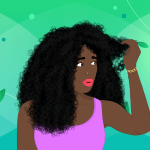
Our hair is as diverse as we are, with a wide range of textures and types that require unique care approaches. Understanding your specific hair type is the first step towards achieving healthy locks. However, this is often difficult to do when there is lacking consensus on a single hair typing method.
What are a few facts we can all agree upon? Hair consists of two key structures: the hair shaft and the hair follicle. The “hair shaft” is the strand of hair itself and is composed of several layers consisting mostly of a protein called keratin. The “hair follicle” sits at the hair’s root, consists of many living cell types, and forms a tube-like structure through which hair strands grow [1]. The shape of your hair follicle is determined by genetics and dictates your hair type and shape. For example, individuals with an S-shaped hair follicle will often have wavy hair [2].
Hair type is often categorized into one of four key buckets: Type 1 (Straight), Type 2 (Wavy), Type 3 (Curly), or Type 4 (Coily). Hair shape is further subdivided based on the appearance of hair per the handy table below [3]:
Hair Type Shape
Type 1: Straight
- 1a: Very straight, fine or thin texture
- 1b: Straight with some bends
- 1c: Straight with a coarser texture
Type 2: Wavy
- 2a: Wavy and fine
- 2b: Wavy with a slightly more defined S-shape
- 2c: Wavy with well-defined S-shaped waves
Type 3: Curly
- 3a: Loose curls
- 3b: Tight and springy curls
- 3c: An S or Z shape that springs back into shape when stretched
Type 4: Coily
- 4a: Loose coils
- 4b: Zig-zagging coils
- 4c: Tight coils
Source: Medical News Today
Note that not all hair will fit discretely into one of the subcategories outlined above. Read on for some tips for ensuring that you are giving your predominant hair type the TLC it needs!
Type 1: Straight Hair
Straight hair often tends to be oilier at the roots and drier towards the ends.
Use a gentle, clarifying shampoo to keep the roots oil-free. Avoid excessive shampooing, as it can strip the hair of natural oils.
Focus conditioning on the mid-lengths and ends of the hair to prevent weighing down the roots. A lightweight conditioner or a leave-in conditioner is ideal.
Use lightweight styling products to avoid weighing down your straight hair. Opt for serums or light-hold mousses.
Type 2: Wavy Hair
Wavy hair strikes a balance between straight and curly and is often prone to frizz and dehydration.
Opt for sulfate-free, moisturizing shampoos to retain natural oils and minimize frizz.
Use a hydrating conditioner to enhance your waves’ natural pattern. Detangling after applying conditioner can prevent breakage.
Scrunch your hair with a curl-enhancing cream, which can help define your waves and control frizz.
Type 3: Curly Hair
Curly hair is characterized by its coils, which can vary from loose to tight curls.
Limit shampooing, as over-shampooing can strip natural oils and lead to dryness. Aim for sulfate-free shampoos and consider co-washing between regular washes.
Use deep conditioning treatments and hydrating masks routinely, as these are essential to maintain bounce and reduce frizz.
Utilize curl-defining products such as gels, creams, or custards to enhance and hold your curls’ shape.
Type 4: Coily Hair
Coily hair has tight, springy curls that require extra care to prevent breakage and maintain moisture.
Opt for co-washing or use a gentle shampoo to cleanse hair without stripping natural oils.
Deep condition regularly to replenish moisture and improve manageability. Consider using leave-in conditioners.
Consider protective styles like twists, braids, or buns to protect fragile hair strands from breakage and promote growth.
Regardless of your hair type and shape, a consistent and personalized hair care routine can help you achieve healthy, vibrant locks.
Bibliography
[1] E. Hoover, M. Alhajj, and J. L. Flores, “Physiology, Hair,” PubMed, 2022.
https://www.ncbi.nlm.nih.gov/books/NBK499948/#:~:text=Each%20hair%20is%20made%20up (accessed Feb. 08,
2022).
[2] S. Thibaut, O. Gaillard, P. Bouhanna, D. W. Cannell, and B. A. Bernard, “Human hair shape is
programmed from the bulb,” British Journal of Dermatology, vol. 152, no. 4, pp. 632–638, Apr. 2005, doi:
https://doi.org/10.1111/j.1365-2133.2005.06521.x.
[3] M. Rees, “Hair: Types and care instructions,” www.medicalnewstoday.com, Jul. 02, 2021.
https://www.medicalnewstoday.com/articles/hair-types#hair-types

Other Articles
A Guide to Nourishing and Reviving Dry Natural Hair